
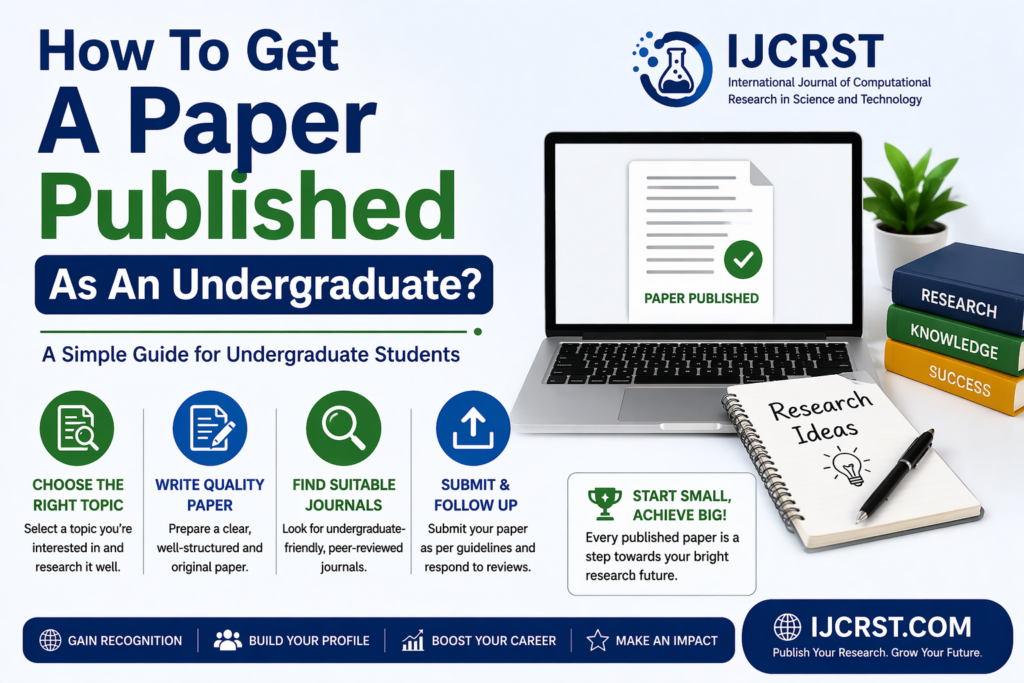
Paper publication proves to be always a very helpful way to get early success for students of different grades. They are often encouraged by their guides, mentors and seniors to prepare research work which helps to create their own identity and institute recognition, where they are pursuing their academics. Here we are going to discuss about how to get a paper published as an undergraduate.
Start with a simple and focused research idea
Choose a topic that genuinely interests you and is manageable at your level. Avoid overly complex problems and instead focus on clarity, relevance, and originality in your approach.
Work under guidance whenever possible
Seeking help from a professor or mentor can significantly improve your work. They can guide you in refining your topic, improving methodology, and avoiding common mistakes.
Article Processing Charges / Submit Manuscript Here
Build a strong foundation through reading
Before writing, read existing research papers related to your topic. This helps you understand how academic writing works and where your idea fits within existing knowledge.in addition, you can have an idea of writing as well.
Follow a clear academic structure
Organize your paper into standard sections such as introduction, literature review, methodology, results, conclusion, and finally references. A well-structured paper makes it easier for reviewers to understand your contribution.
Focus on clarity over complexity
Many undergraduate papers get rejected because they try to sound too advanced. Instead, aim for clear explanations, simple language, and logical flow of ideas.
Maintain originality and proper citations
Always write in your own words and give credit to sources you use. Plagiarism can lead to immediate rejection, so honesty in writing is essential.
Edit and proofread carefully
Check for grammar, spelling, and formatting errors before submission. A clean and polished paper creates a strong impression.
Share your work on academic platforms
Uploading your paper to free platforms can help you gain visibility and feedback, which can improve your chances of formal publication.
Be prepared for feedback and revisions
Reviewers may suggest changes. Accept feedback positively, revise your work, and resubmit if needed. This is a point in the paper publication journey, don’t feel low.
Stay patient and keep improving
Success may not come immediately. Use each attempt as a learning experience and continue refining your skills.
In the end, publishing as an undergraduate is less about perfection and more about effort, curiosity, and consistency. If you stay committed to learning and improving, you can successfully publish your research and build a strong academic foundation early in your career.
